What is Ikigai?
Ikigai (生き甲斐) is a Japanese concept that means "reason for being." It is the thing that gets you out of bed each morning - the intersection of passion, mission, vocation, and profession. For millions of Japanese people, ikigai is not a lofty philosophical ideal but a practical, lived experience that shapes how they approach each day.
Short answer
Ikigai means the reason life feels worth living.
It can be a career direction, a craft, a relationship, a daily ritual, or a small source of meaning. The modern four-circle model is useful for reflection, but ikigai itself is broader than a job or productivity framework.
The Meaning of Ikigai
The word ikigai is made of two parts: iki (生き), meaning "life," and gai (甲斐), meaning "worth" or "value." Together, they describe the worth of living - your reason to exist. The concept has deep roots in Japanese culture, appearing in literature as far back as the Heian period (794–1185), where "gai" referred to the shell of a particularly prized type of clam - something precious and worth seeking.
In modern Japanese, ikigai carries a warm, intimate connotation. It is not about grandiosity or world-changing ambitions. When a Japanese person says "kore ga watashi no ikigai desu" (これが私の生き甲斐です), they might be talking about their grandchild, their garden, their morning walk, or their craft. It is fundamentally personal.
Psychologist Michiko Kumano (2017) describes ikigai as a state of wellbeing that arises from devotion to activities one enjoys, which also brings a sense of fulfilment. Importantly, she notes that ikigai is not the same as happiness (幸福, kōfuku). Happiness can be fleeting and circumstantial; ikigai is more enduring - it is the underlying current that gives your life direction even during difficult times.
Unlike Western concepts of "finding your passion," ikigai is more nuanced. It can be grand (your life's work) or small (your morning tea). It is deeply personal and often evolves throughout your life. Many Japanese people describe having multiple ikigai - a concept that feels foreign to Westerners conditioned to search for "the one thing."
Ikigai in Okinawa: The Island of Long Life
Okinawa, the southernmost prefecture of Japan, is one of the world's five "Blue Zones" - regions where people live significantly longer than the global average. With more centenarians per capita than almost anywhere on Earth, Okinawa has fascinated longevity researchers for decades.
When researchers from the National Geographic Blue Zones project visited Okinawa, they asked the elderly residents about the secret to their long lives. The answer was consistent: ikigai. The Okinawan concept of ikigai is inseparable from daily life. There is no word for "retirement" in the traditional Okinawan dialect. Instead, people continue doing what gives them purpose well into their nineties and beyond.
A 97-year-old karate master's ikigai might be teaching his art. A 102-year-old woman's ikigai might be holding her great-great-grandchild. A fisherman who has worked the sea for seventy years finds ikigai in the rhythm of the tides. These are not abstract philosophies - they are the lived experiences of people who have found deep meaning in the ordinary.
A landmark 2008 study by Tohoku University followed 43,000 Japanese adults over seven years. The results were striking: participants who reported having a clear ikigai had significantly lower risk of cardiovascular disease and lower all-cause mortality rates compared to those who did not feel a sense of purpose. Even after controlling for age, gender, education, BMI, smoking, alcohol use, and other factors, the ikigai effect persisted.
Beyond Okinawa, the concept resonates across all of Japan. Annual government surveys show that roughly 75% of Japanese adults report having an ikigai, and those who do consistently score higher on measures of life satisfaction, social connection, and physical health.
The Western Diagram vs. Real Ikigai: The Marc Winn Story
If you have ever searched for "ikigai" online, you have almost certainly seen the famous four-circle Venn diagram: Love, Good At, World Needs, and Paid For, with "Ikigai" at the centre. This diagram has become so ubiquitous that most people assume it is a traditional Japanese concept. It is not.
The diagram was created in 2014 by Marc Winn, a British blogger living on the island of Jersey. In a blog post, Winn took two separate concepts - the Japanese idea of ikigai and a "purpose Venn diagram" originally created by Spanish astrologer Andrés Zuzunaga - and merged them into a single image. The post went viral. Within months, the diagram was being shared by TED speakers, career coaches, and self-help authors as if it were an ancient Japanese tradition.
Marc Winn himself has spoken about the unexpected virality. He never claimed the diagram was Japanese. It was a personal mash-up, a blog post written in about fifteen minutes. But the internet does not care about attribution, and the "ikigai Venn diagram" became the default way the West understands ikigai.
This matters because the Venn diagram implies that ikigai requires the intersection of four external conditions - including being paid. In Japan, ikigai has nothing to do with money. A retired grandmother tending bonsai trees has ikigai. A child playing in a stream has ikigai. The Japanese concept is about subjective fulfilment, not career optimisation.
That said, the four-circle framework is a powerful tool for self-reflection, especially for people navigating career transitions or midlife crises. We use it as a starting point on this site - not as the entire picture. Think of the diagram as a Western lens on a Japanese idea: useful, but incomplete.
The Four Circles of Ikigai Explained
Tap any area to explore the map
The popular ikigai framework asks you to explore four fundamental questions. Each circle represents a dimension of your life, and the overlaps between them create four additional states: Passion, Mission, Profession, and Vocation.
❤️ What You Love (Passion & Joy)
This is the most intuitive circle. What activities make you lose track of time? What would you do even if nobody was watching and you were never paid? Love is the emotional engine of ikigai. It encompasses hobbies, creative pursuits, curiosities, and the things that light you up. For some people, this is painting. For others, it is solving complex mathematical problems. There is no hierarchy - only honesty.
To explore this circle, pay attention to what you gravitate toward in your free time. Notice what topics you read about obsessively. Remember what you loved as a child before the world told you to be "practical."
⭐ What You're Good At (Skills & Talents)
This circle is about competence - the skills that come naturally to you and the expertise you have built over time. It includes both innate talents and developed abilities. What do people consistently ask you for help with? What comes easily to you that others find difficult?
An important nuance: what you are good at and what you love are not always the same thing. You might be an excellent accountant but find no joy in spreadsheets. Conversely, you might love singing but lack the skill to perform professionally. The magic happens when these two circles overlap - that is Passion.
🌍 What the World Needs (Mission & Purpose)
This is the outward-facing circle. It asks you to look beyond yourself and consider the needs of others. What problems in your community, industry, or the world at large do you feel compelled to address? What injustices make you angry? What suffering do you want to alleviate?
This circle grounds ikigai in service. Without it, you risk becoming self-absorbed - talented and passionate but disconnected from the world. When Love meets World Needs, you have a Mission - a calling that transcends personal satisfaction.
💰 What You Can Be Paid For (Value & Sustainability)
The most pragmatic circle. In the real world, sustaining yourself matters. This circle asks: where does your value meet the market? What skills, services, or creations will others exchange money for? This is not about greed - it is about sustainability. Even monks need food.
When Good At meets Paid For, you have a Profession. When World Needs meets Paid For, you have a Vocation. The trick is finding work that touches all four circles simultaneously.
The Four Overlaps
- Passion (Love + Good At) - You enjoy it and you excel at it, but it may not pay the bills or serve the world.
- Mission (Love + World Needs) - You feel called to make a difference, but you may lack the skills or financial model.
- Profession (Good At + Paid For) - You earn well and perform well, but you may feel empty inside.
- Vocation (World Needs + Paid For) - You serve the world and get paid, but burnout looms if you do not love the work.
Where all four circles overlap is your ikigai - the sweet spot where passion, talent, purpose, and livelihood meet. It is rare, and it is worth pursuing.
Ikigai vs. Purpose vs. Passion: What's the Difference?
In the self-help world, "purpose," "passion," and "ikigai" are often used interchangeably. But they are meaningfully different concepts.
Passion is an intense emotional drive toward a specific activity or subject. It is hot, consuming, and sometimes fleeting. The Western advice to "follow your passion" puts enormous pressure on finding one thing you love - and can lead to paralysis when that single thing does not materialise.
Purpose is a broader sense of direction - the "why" behind your actions. Purpose tends to be outward-facing: it is about contribution and impact. Viktor Frankl wrote about purpose as the key to surviving suffering. Purpose is noble but can feel heavy - an obligation rather than a joy.
Ikigai sits between these two. It includes the warmth of passion and the direction of purpose, but it adds two critical elements: pragmatism (can you sustain it?) and lightness (it can be small). Your ikigai does not need to be your career. It does not need to change the world. It just needs to make your life feel worth living.
This is why ikigai resonates with so many people who feel burnt out by the "hustle culture" narrative. It gives you permission to find meaning in quiet, ordinary things - while also providing a framework for aligning your work with your values if you choose to.
How to Find Your Ikigai: A Step-by-Step Guide
Finding your ikigai is not a one-time event - it is a journey of self-exploration that unfolds over months and years. Here is a practical, step-by-step approach:
- Start with curiosity, not answers. Instead of asking "What is my ikigai?" ask "What am I curious about?" Buy a notebook and spend two weeks writing down every moment you feel energised, engaged, or alive. Do not judge or filter - just observe.
- Map your four circles. Dedicate one page to each: Love, Good At, World Needs, Paid For. Brainstorm freely. For "Good At," ask five friends or colleagues: "What do you think I'm uniquely good at?" Their answers will surprise you.
- Look for overlaps. Lay your four lists side by side. Where do themes repeat? If "teaching" appears in Love and Good At, and "education inequality" appears in World Needs, you are seeing your ikigai emerge.
- Prototype, don't plan. Ikigai is discovered through action, not analysis. Try small experiments: volunteer for a week, take an online course, start a side project. Pay attention to what gives you energy and what drains you.
- Embrace evolution. Your ikigai at 25 will differ from your ikigai at 45. Life changes - careers shift, relationships deepen, health fluctuates. Revisit your four circles annually. Ikigai is not a destination; it is a practice.
- Seek community. In Okinawa, ikigai is supported by "moai" - small social groups that provide emotional and financial support throughout life. Find your moai: a mastermind group, a close friend circle, a mentor. Ikigai is personal, but it does not have to be solitary.
Ikigai in Daily Life
One of the most beautiful aspects of ikigai is that it does not require dramatic life changes. You do not need to quit your job, move to Okinawa, or reinvent yourself. Ikigai can be woven into the fabric of your everyday life.
Morning rituals. Many Japanese centenarians describe their morning routine as a source of ikigai. The act of making tea, tending a garden, or greeting the sunrise creates a sense of purpose that anchors the day. Consider: what small ritual could you add to your morning that brings genuine joy?
Work with intention. Even if your job is not your dream career, you can bring ikigai to it. Focus on the aspects you enjoy. Invest in relationships with colleagues. Find ways to add value that align with your strengths. The Japanese concept of "shokunin kishitsu" (職人気質) - the artisan spirit - means taking deep pride in your craft, no matter how humble.
Relationships as ikigai. For many people, their deepest ikigai is relational: being a good parent, a supportive friend, a loving partner. Research consistently shows that social connection is one of the strongest predictors of longevity and wellbeing. In Okinawa, the moai system ensures that no one faces life alone.
Staying active. Okinawan elders maintain physical activity not through gym memberships but through daily tasks: gardening, walking to the market, cooking from scratch. Movement is embedded in their lifestyle. Finding physical activities you enjoy - walking, swimming, dancing - is itself a form of ikigai.
Best next step
If you want to find your ikigai, start with Ikigai Report.
Reading about ikigai helps, but most people get unstuck faster with a structured reflection path. Ikigai Report is built for that: a free 3-minute test, a clear archetype, a four-circle breakdown, and practical next steps you can test in real life.
Use this guide for context, then use the worksheet or test to turn the idea into something personal. The goal is not to admire the concept. The goal is to notice a pattern you can actually act on.
Downloadable tools
Download the worksheet, diagram, and statement template
These original tools are designed to make the concept useful, not just interesting. Use them after reading the guide, or take the free test first and bring your result back to the worksheet.
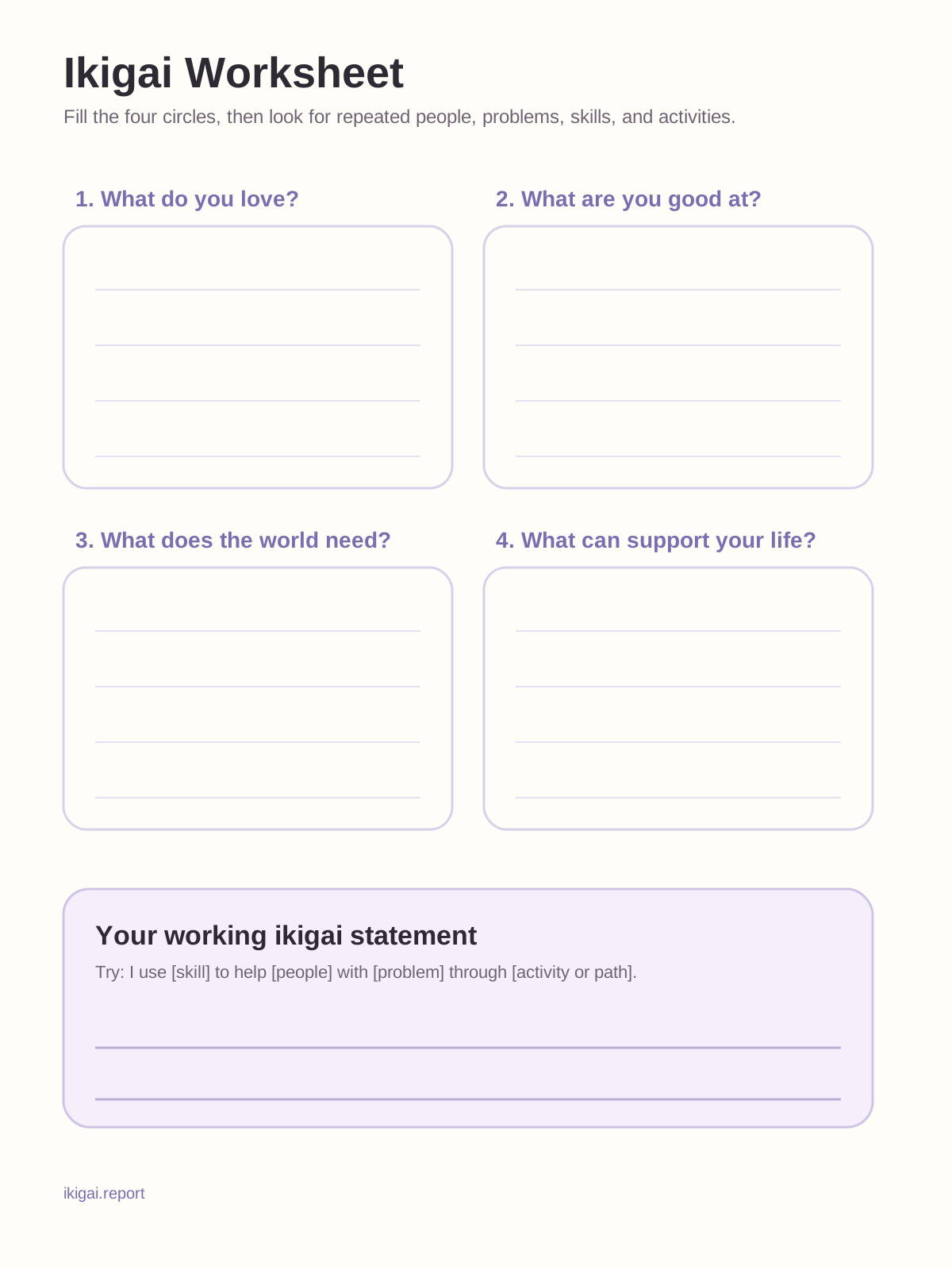
Printable Ikigai Worksheet
A one-page worksheet for mapping the four circles and writing a clear ikigai statement.
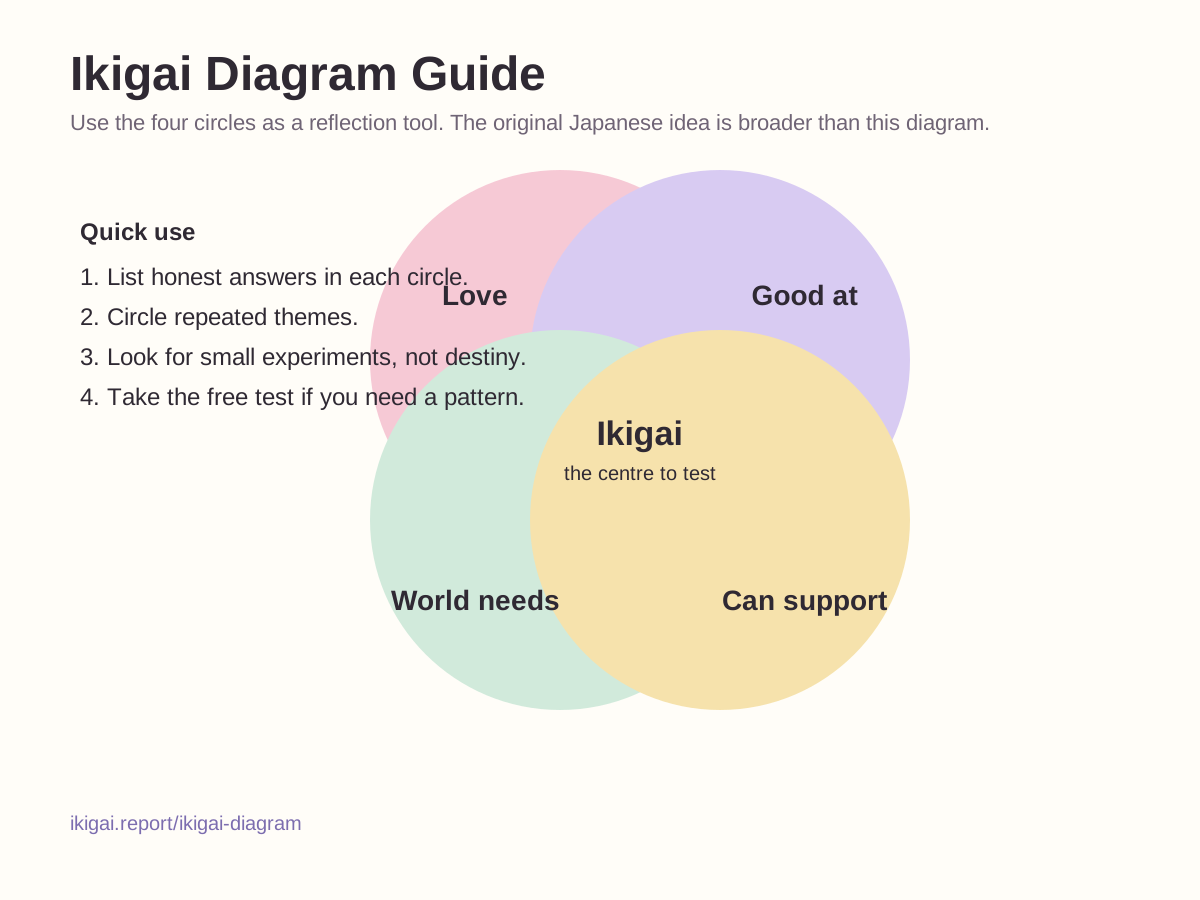
Ikigai Diagram Guide
A clean visual guide to the four circles, classic overlaps, and centre point.
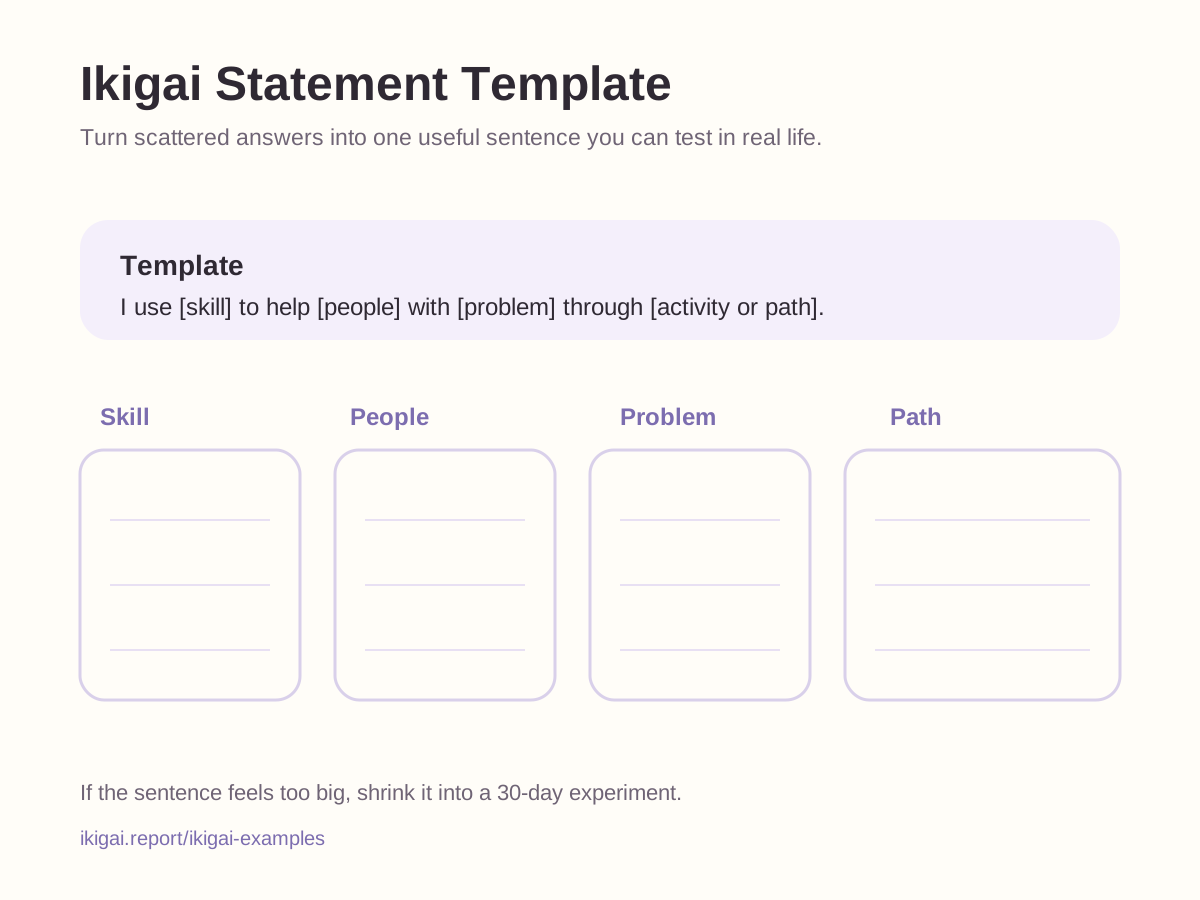
Ikigai Statement Template
A practical template for turning scattered answers into a usable sentence.
Use this guide with the practical tools
These core guides work together: start with the concept, use the diagram or worksheet, then take the personalised test when you want a clear result.
Common Misconceptions About Ikigai
❌ "Ikigai is the Japanese word for the Venn diagram."
The Venn diagram was created by a British blogger in 2014. Ikigai is a centuries-old Japanese concept that has nothing to do with career frameworks. The diagram is a useful Western adaptation, but it is not ikigai itself.
❌ "You need to find your ONE ikigai."
In Japanese culture, you can have many ikigai - your garden, your grandchildren, your morning coffee, your volunteer work. The pressure to find "the one thing" is a Western overlay. Give yourself permission to have multiple sources of meaning.
❌ "Ikigai must involve your career."
Many Japanese people's ikigai has nothing to do with their job. A salaryman's ikigai might be his weekend fishing trips. A teacher's ikigai might be her ceramic pottery hobby. Career alignment is wonderful when possible, but it is not a requirement.
❌ "Once you find your ikigai, you're set for life."
Ikigai evolves. What gave you purpose at 20 may not sustain you at 50. Life transitions - parenthood, retirement, loss - naturally reshape your ikigai. The practice is in continual rediscovery, not in finding a permanent answer.
❌ "Ikigai is only for Japanese people."
While ikigai is a Japanese concept, the human need for meaning is universal. Every culture has its own version: the Danish "hygge," the French "raison d'être," the Hindu "dharma." Ikigai simply provides a particularly elegant framework for exploring this universal need.
The Science Behind Ikigai
Beyond the Tohoku University study, a growing body of research supports the health benefits of having a strong sense of purpose - which is closely aligned with ikigai.
A 2019 JAMA Network Open study of nearly 7,000 American adults over 50 found that those with the strongest sense of purpose had a mortality rate that was 15.2% lower than those with the weakest sense of purpose over the four-year study period.
Neuroscience research suggests that purposeful living activates the prefrontal cortex and reduces activity in the amygdala (the brain's fear centre), leading to better emotional regulation and reduced stress. People with a clear sense of purpose also show higher levels of DHEA (a hormone associated with wellbeing) and lower levels of cortisol (the stress hormone).
In practical terms, having an ikigai appears to improve sleep quality, boost immune function, reduce the risk of Alzheimer's disease, and promote cardiovascular health. It is not a magic cure - but it is a remarkably consistent predictor of wellbeing across cultures and age groups.
People Also Ask About Ikigai
Is ikigai the same as purpose?
Not exactly. Purpose tends to be outward-facing and heavy - a calling to serve. Ikigai is warmer and more personal. It includes purpose but also encompasses small joys like morning tea or gardening. You can have ikigai without a grand mission.
How do I find my ikigai?
Start by exploring four questions: What do you love? What are you good at? What does the world need? What can you be paid for? Try our free 3-minute test for a personalised result, or use the ikigai worksheet for deeper reflection.
Is the ikigai diagram Japanese?
No. The popular four-circle Venn diagram was created by Marc Winn, a British blogger, in 2014. He merged the Japanese concept of ikigai with a separate purpose framework. Traditional Japanese ikigai is broader and more personal.
Can you have more than one ikigai?
Yes! In Japanese culture, people commonly have multiple ikigai - a hobby, a relationship, a daily ritual, their work. The Western idea of finding "the one thing" is a simplification of the original concept.
Discover Your Ikigai in 3 Minutes
Our free personalised test assigns you one of 12 ikigai archetypes based on your unique answers.
Take the Free Test →