Free ikigai worksheet
Ikigai worksheet: fill in the four circles
This ikigai worksheet gives you prompts, sample answers, and a printable four-circle template. Write your own answers, then look for a small next step.
3 minutes. Free result. No sign-up required.












The worksheet is built around these four questions
What do you love?
The activities, people, and rituals that make life feel worth showing up for.
What are you good at?
The strengths others notice in you, including skills that feel almost too natural.
What does the world need?
The problems, people, or moments you feel quietly pulled to help with.
What can be sustained?
The work, habits, services, or roles that can survive in real life.
Short answer
An ikigai worksheet turns vague purpose questions into visible patterns.
Write specific answers for each circle, then look for repeated people, problems, skills, and activities. If you want a guided starting point before writing by hand, take the free test and bring your result back to this worksheet.
❤️ Circle 1: What You Love
What activities make you lose track of time? What would you do even if nobody was watching?
1.
2.
3.
4.
5.
⭐ Circle 2: What You're Good At
What skills come naturally to you? What do people praise you for or come to you for help with?
1.
2.
3.
4.
5.
🌍 Circle 3: What the World Needs
What problems frustrate you? What suffering do you want to help alleviate?
1.
2.
3.
4.
5.
💰 Circle 4: What You Can Be Paid For
What value can you offer that others would pay for? Think broadly - jobs, freelancing, products, services.
1.
2.
3.
4.
5.
🎯 Your Ikigai
Look at all four circles. What patterns do you see? Where do they overlap? Write your ikigai in one sentence:
Ikigai worksheet questions and sample answers
If you are not sure what to write, start with short, concrete answers. These examples show the level of detail that makes the worksheet useful.
What you love
Sample answer: Quiet mornings, explaining ideas, making visual notes, helping friends untangle choices.
What you are good at
Sample answer: Listening carefully, simplifying complex topics, noticing patterns, finishing what I start.
What the world needs
Sample answer: Less overwhelm, more patient teaching, practical support for people making hard decisions.
What you can be paid for
Sample answer: Coaching, teaching, writing guides, building simple systems, advisory work.
How to Get Better Answers From This Worksheet
The best worksheet answers are specific and ordinary. Instead of writing “help people,” write the type of person you want to help, the problem they face, and the moment when your help would matter.
If the Paid For circle feels uncomfortable, treat it as sustainability rather than greed. Ask: what would let this source of meaning survive in real life? That might be a job, a service, a product, a grant, a community role, or a small side project.
After you fill the worksheet, look for repeating nouns and verbs. If “teaching,” “calm,” and “young people” appear in several circles, that pattern is more useful than trying to force a perfect sentence immediately.
Best next step
Use the worksheet with your Ikigai Report result.
The worksheet is best when you already have a starting pattern. Take the free test first if your answers feel scattered, then use the worksheet to turn your archetype and four-circle breakdown into a practical sentence.
If you prefer pen and paper, download the printable version below. If you want an instant interpretation, start with the free test.
Turn your worksheet into an ikigai statement
After you fill the four circles, do not look for a magical perfect answer. Look for repeat patterns, then draft one sentence you can test this month.
Statement formula
I use [strength] to help [people] with [need] through [activity, role, service, or habit].
Worksheet pattern
Love: explaining ideas. Good at: patient teaching. Need: anxious students. Sustainable path: tutoring or lesson design.
One-sentence answer
I use patient teaching to help anxious students understand difficult ideas through simple lessons and examples.
For more examples before you write, use the ikigai examples and sample answers page, or open the Ikigai Statement Generator.
Free statement generator
Ikigai Statement Generator
Write rough notes in the four boxes. This tool creates sample ikigai statements in your browser only. Nothing is saved, sent, or stored.
Statement formula
I use [strength] to help [people] with [need] through [activity, role, service, or habit].
Clear and practical
My ikigai is using my natural strengths to help people who need practical help through a sustainable path, role, project, or daily practice.
Warm and personal
I feel most alive when I combine the work that gives me energy with my natural strengths, especially when it helps people who need practical help.
Career friendly
A sustainable expression of my ikigai is a sustainable path, role, project, or daily practice, where I can use my natural strengths in service of people who need practical help.
Simple one-liner
I use my natural strengths to turn the work that gives me energy into practical help for people who need practical help.
Next experiment
This month, I can test my ikigai by using my natural strengths in a small a sustainable path, role, project, or daily practice experiment for people who need practical help.
Downloadable tools
Download the printable worksheet and templates
These original tools are designed to make the concept useful, not just interesting. Use them after reading the guide, or take the free test first and bring your result back to the worksheet.
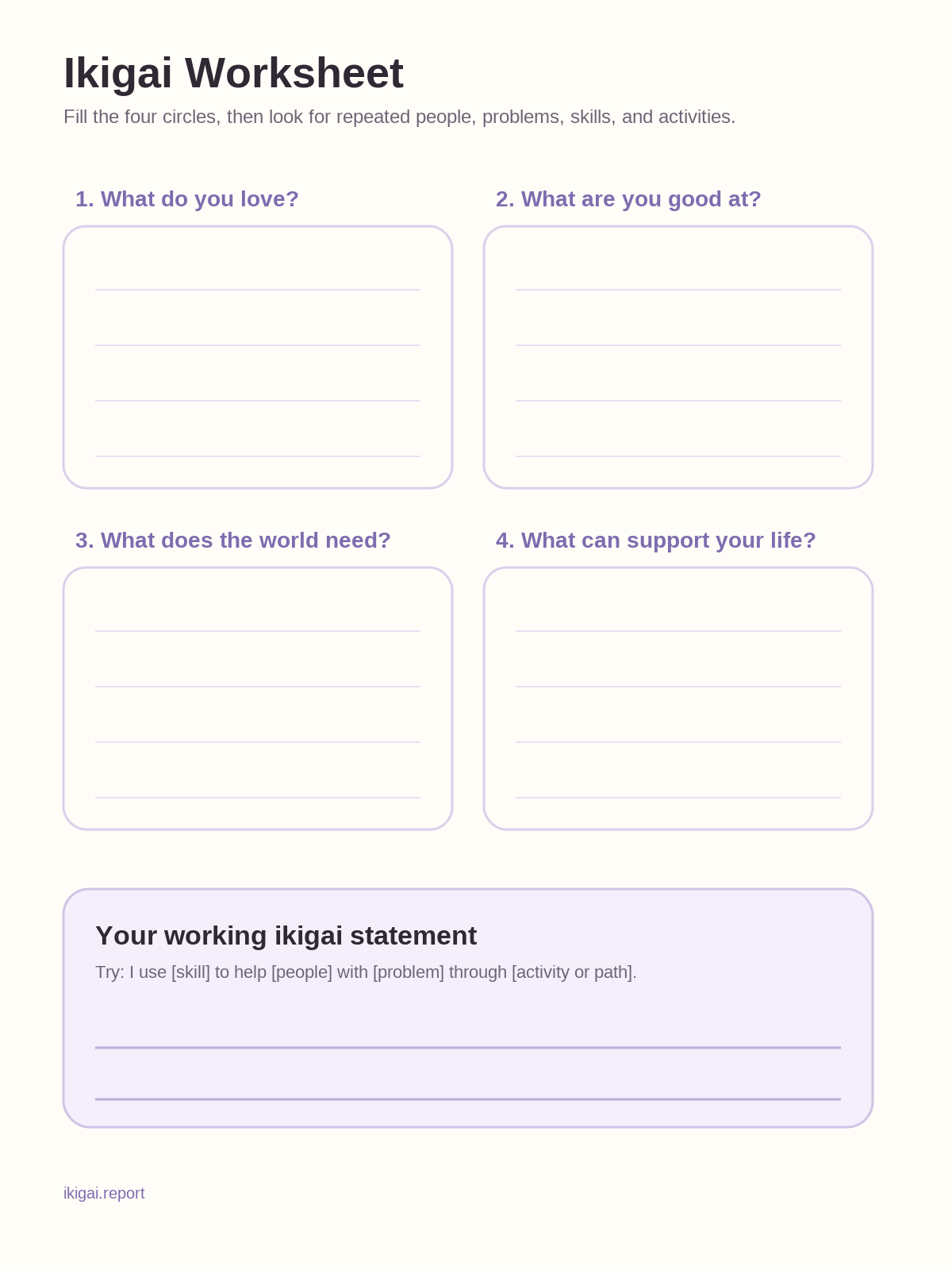
Printable Ikigai Worksheet
A one-page worksheet for mapping the four circles and writing a clear ikigai statement.
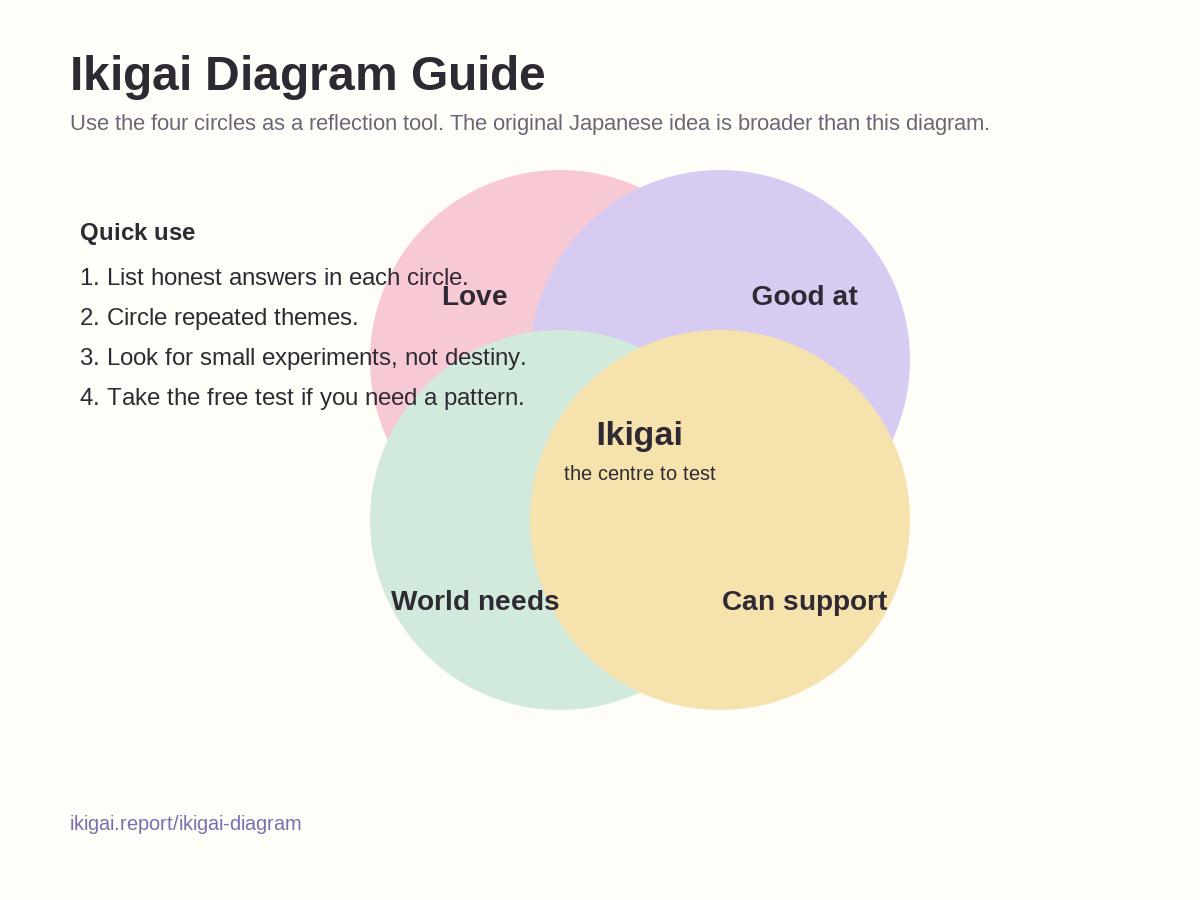
Ikigai Diagram Guide
A clean visual guide to the four circles, classic overlaps, and centre point.
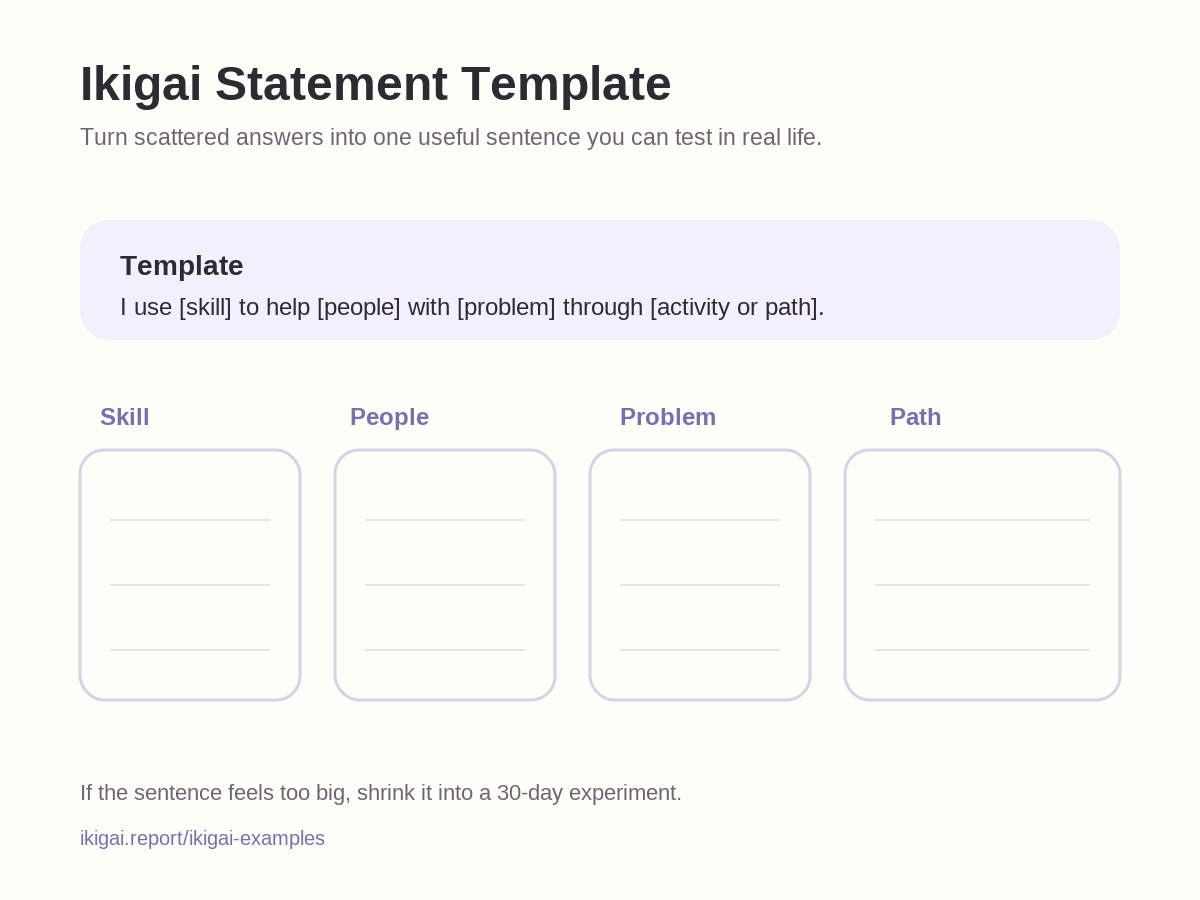
Ikigai Statement Template
A practical template for turning scattered answers into a usable sentence.
Use the worksheet with these guides
These core guides work together: start with the concept, compare examples, use the diagram or worksheet, then take the personalised test when you want a clear result.
Free Ikigai Test
Answer five guided questions and get your personalised Ikigai Archetype.
What is Ikigai?
Read the full guide to the Japanese idea, the Western diagram, and common myths.
Ikigai Diagram Guide
Explore the four circles, their overlaps, and how to use the diagram well.
Ikigai Examples and Sample Answers
Read sample ikigai statements and real examples before writing your own.
Ikigai Statement Generator
Generate sample ikigai statements from your four-circle notes without saving inputs.
Want the faster starting point?
Take the free test first, then use this worksheet to refine your archetype into a practical ikigai statement.
Take the Free Test